Short answer: Digital marketing is the promotion of products, services or ideas through digital channels such as search engines, AI assistants, social media, email, WhatsApp, websites and online ads. Unlike TV, print or radio, almost every digital marketing activity can be targeted to a specific audience and measured, so you can see what works and spend more on it.
If someone found your business through a Google search, an Instagram reel, a ChatGPT recommendation or a WhatsApp message, that was digital marketing at work. This guide explains what it includes, how the pieces fit together, and how to start learning it.
Digital marketing vs traditional marketing
Both aim to win customers. The difference is in how you reach people and how much you can measure.
| Traditional marketing | Digital marketing | |
|---|---|---|
| Examples | TV, newspapers, radio, hoardings, flyers | Google, Instagram, YouTube, email, WhatsApp, websites |
| Targeting | Broad: everyone who sees it | Precise: by location, age, interests and intent |
| Measurement | Estimated reach | Clicks, leads and sales tracked to the source |
| Budget | Usually a large upfront cost | Start small and scale what works |
| Changes | Slow and expensive to change | Can be adjusted the same day |
| Conversation | One-way | Two-way: comments, messages, reviews |
Most businesses still use some traditional marketing. Digital marketing is where you can test ideas cheaply, learn quickly, and prove return on investment.
The main types of digital marketing
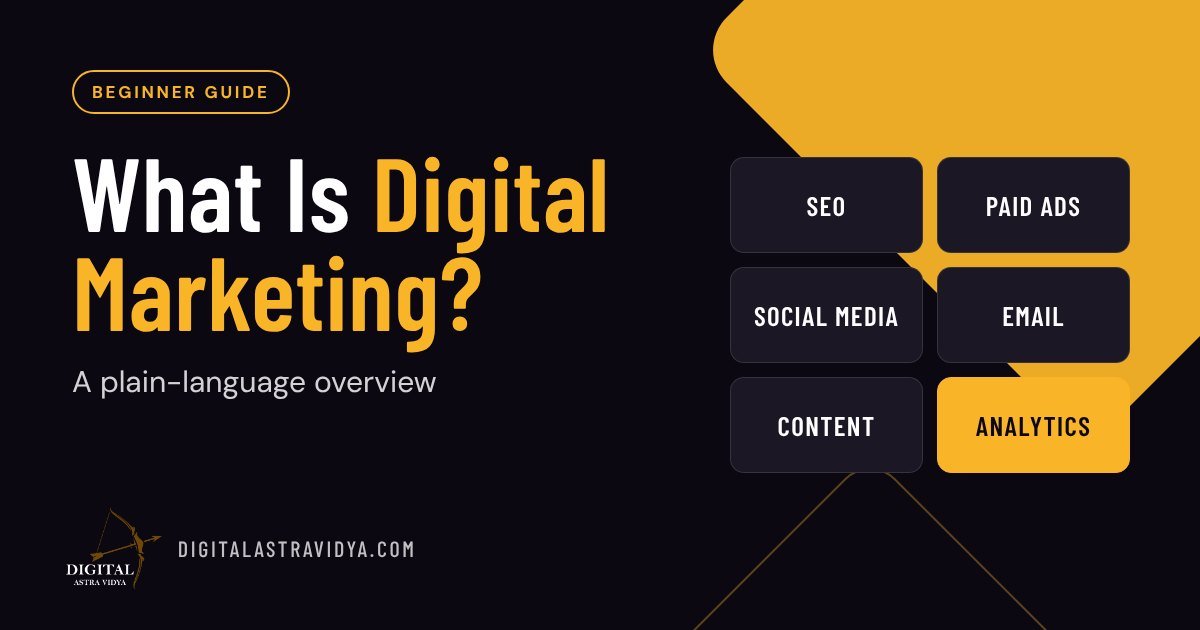
Digital marketing is not one skill. It is a set of connected channels, each with its own tools and logic.
1. Search engine optimisation (SEO)
SEO means improving your website so it appears in Google’s unpaid results when people search for what you offer. It is slower to build but keeps bringing visitors without paying for each click. See SEO vs SEM: What’s the Difference?
2. AI search visibility (GEO and AEO)
More people now ask ChatGPT, Gemini, Perplexity or Google’s AI Overviews for recommendations instead of scrolling through links. Generative engine optimisation (GEO) and answer engine optimisation (AEO) are about making sure these AI tools understand, trust and mention your brand. Read the complete guide to AI search visibility.
3. Paid search (SEM and Google Ads)
Paid search places your ad at the top of Google results for chosen keywords. You pay when someone clicks, and you can appear the same day. It works best for capturing people who are already looking to buy.
4. Social media marketing
This covers building a presence on Instagram, LinkedIn, YouTube, Facebook or X, through regular posts (organic) and paid ads. Social media is strong for creating awareness and trust before people are ready to buy. Start with Social Media Marketing 101.
5. Content marketing
Content marketing means creating useful articles, videos, guides and posts that answer your audience’s questions. Good content feeds SEO, social media, email and AI search at the same time.
6. Email and WhatsApp marketing
These channels let you message people who have chosen to hear from you: offers, updates, reminders and newsletters. In India, WhatsApp Business is often the fastest way to turn an enquiry into a sale.
7. Influencer and affiliate marketing
Influencer marketing uses creators your audience already follows. Affiliate marketing pays partners a commission for each sale they bring. Both borrow trust that would take a brand years to build alone.
8. Analytics and measurement
Analytics ties everything together. Tools like Google Analytics 4 show where visitors come from, what they do and which channels bring leads or sales, so decisions are based on data, not guesswork. See How to Read a Google Analytics Dashboard.
Paid search, paid social and affiliate marketing together are often called performance marketing, because you pay for measurable results.
How the channels work together: the marketing funnel
A simple way to see the whole picture is a funnel with three stages. Every channel fits somewhere in it.
- Awareness: people discover your business (social media, content, SEO, AI search, display ads).
- Consideration: people compare you with alternatives (your website, reviews, case studies, email).
- Conversion: people buy, sign up or enquire (search ads, landing pages, WhatsApp follow-ups, offers).
Knowing which stage a channel serves tells you what to measure and where to start. Learn more in What Is a Marketing Funnel?
A real example: a neighbourhood bakery
Imagine a small bakery opening in a new area. A simple, low-budget digital marketing plan could look like this:
- A complete Google Business Profile with photos and opening hours, so it appears for “bakery near me” (local SEO).
- Instagram reels of fresh bakes three times a week (social media).
- A small local ad campaign for opening week, targeted to people within 3 km (paid social).
- A WhatsApp Business catalogue for orders, with a weekly message about new items (WhatsApp marketing).
- Asking happy customers for Google reviews, which also helps AI tools recommend it.
None of this needs a big budget or a marketing degree. It needs a clear goal and the right channel for each step.
Why businesses invest in digital marketing
- You can measure it: see which channel brought each lead or sale.
- You can target it: reach people by location, interests and what they are searching for.
- You can start small: test with a modest budget and scale what works.
- You can change it quickly: fix a weak ad or page the same day.
- It builds lasting assets: a website, content, reviews and an audience that keep working for you.
Skills you need to work in digital marketing
Digital marketing is a practical skill, and most of it can be learned without a technical background. The core skills are:
- Understanding your audience and what they search for
- Writing clear content and ads
- Running campaigns on Google Ads and Meta (Facebook and Instagram) Ads
- Basic SEO and how AI search tools choose sources
- Reading analytics and making decisions from data
- Using AI tools responsibly to work faster
- Updating a website through a content management system such as WordPress (see What Is a CMS?)
Common roles include SEO specialist, performance marketer, social media manager, content marketer and digital marketing manager. Many freelancers and business owners use the same skills to grow their own work.
How to start learning digital marketing
- Learn the basics first: channels, the funnel and key terms.
- Pick one channel that fits your goal, such as SEO, social media or Google Ads, and go deep.
- Practise on something real: your own page, a friend’s business or a small test budget.
- Learn to measure: set up Google Analytics 4 and track one goal.
- Add the next channel once the first is working, and keep learning as platforms and AI change.
Our free Knowledge Paths take you from beginner to advanced. If you prefer to learn with a trainer, see our online digital marketing training, available as one-on-one or group classes.
Frequently asked questions
Is digital marketing hard to learn?
No. The basics can be learned in a few weeks, and most skills are practical rather than technical. Becoming good takes regular practice on real campaigns.
Can I learn digital marketing online?
Yes. Free guides, platform certifications and live online classes are all effective. A structured course with a practising trainer helps you learn faster and avoid common mistakes.
What is the difference between digital marketing and SEO?
SEO is one part of digital marketing. Digital marketing also includes paid ads, social media, email, content, AI search visibility and analytics.
Do small businesses need digital marketing?
Yes. Customers search online before they buy, even for local shops and services. A complete Google Business Profile, a simple website and an active social or WhatsApp presence are often enough to start.
Is digital marketing still relevant with AI?
More than ever. AI is changing how people search and how marketers work, but businesses still need to be found, trusted and chosen. Understanding AI search and using AI tools well are now part of the job.