
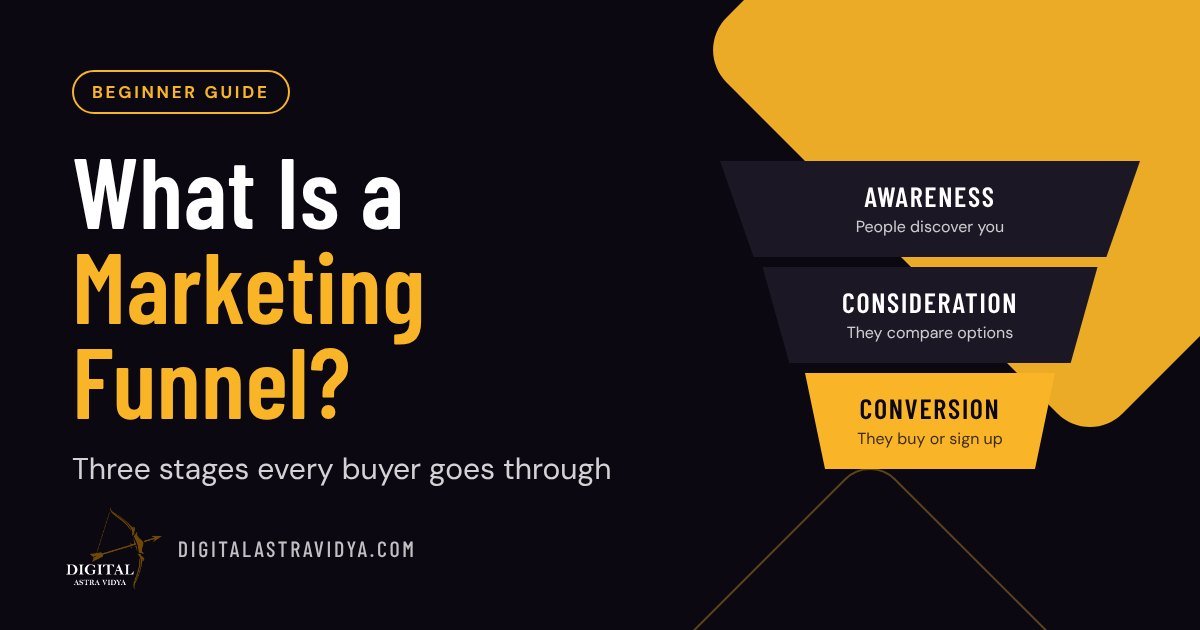
Short answer: A marketing funnel is a simple model of the journey people take from first hearing about your business to becoming a customer. It has three core stages: awareness (they discover you), consideration (they compare you with alternatives) and conversion (they buy or enquire). It is shaped like a funnel because many people enter at the top and fewer move on at each stage.
Understanding the funnel is one of the most useful things a beginner can learn. It explains why different marketing activities exist, what job each one does, and what you should measure at every step.
The three core stages of a marketing funnel
1. Awareness (top of the funnel, TOFU)
People discover that your business exists. They are not ready to buy yet; they may not even know they need a solution. Your job here is to get noticed and be useful.
What works: social media posts and reels, helpful blog articles that rank on Google, YouTube videos, being mentioned in AI answers, and broad awareness ads.
2. Consideration (middle of the funnel, MOFU)
People know you exist and are comparing you with other options. They read reviews, compare prices, check your website and ask questions. Your job here is to build trust.
What works: case studies, comparison pages, customer reviews, detailed guides, webinars, email or WhatsApp follow-ups and retargeting ads.
3. Conversion (bottom of the funnel, BOFU)
People are ready to act: buy, book a call, sign up or send an enquiry. Your job here is to remove friction and make the next step obvious.
What works: clear pricing, a fast and focused landing page, a simple form or checkout, search ads for high-intent keywords, offers and a strong call to action.
After the sale: retention and advocacy
Many marketers now extend the funnel past the first purchase, because keeping a customer is usually cheaper than finding a new one.
- Retention: helping customers succeed so they buy again or renew (onboarding emails, support, loyalty offers).
- Advocacy: turning happy customers into promoters through reviews, referrals and word of mouth, which feeds new people back into the top of the funnel.
The funnel at a glance
| Stage | The customer is thinking | Content that fits | What to measure |
|---|---|---|---|
| Awareness | “I have a problem” or “this looks interesting” | Social posts, blog articles, videos, awareness ads | Reach, impressions, new visitors, branded searches |
| Consideration | “Which option is right for me?” | Guides, case studies, reviews, comparisons, webinars | Engagement, return visits, email or WhatsApp sign-ups |
| Conversion | “I’m ready, is this easy and safe?” | Landing pages, offers, demos, free trials | Conversion rate, leads, sales, cost per acquisition |
| Retention | “Was this worth it?” | Onboarding, tips, loyalty offers, support | Repeat purchases, renewals, customer lifetime value |
Measuring every stage, not only sales, shows you where people drop out. Learn how in Building a Full-Funnel Measurement Strategy.
Why the funnel matters for beginners
A common beginner mistake is asking one piece of marketing to do everything: a 15-second ad that tries to introduce the brand, build trust and close a sale at once. It usually does none of these well.
Once you understand the funnel, you can ask a better question about any post, ad or email: “Which stage is this for?” A blog post about a common problem is awareness content; its job is to be found, not to sell. A detailed case study is consideration content; its job is to build trust. A landing page with an offer is conversion content; its job is to get the enquiry.
Real examples
A project management software company
- Awareness: a blog post titled “5 Signs Your Team Needs Better Project Tracking” attracts people who have the problem but don’t know the company yet.
- Consideration: a comparison page and customer testimonials help people judge whether it is the right fit.
- Conversion: a free trial with no credit card removes the risk of trying.
- Retention: onboarding emails help new users get value in their first week, so they stay.
A home-tuition centre in Pune
- Awareness: Instagram reels with quick exam tips reach parents and students in the city.
- Consideration: Google reviews, results from past students and a free demo class video build trust.
- Conversion: a “Book a free demo” button that opens WhatsApp makes enquiring effortless.
- Advocacy: a referral discount for existing parents brings in new families.
In both cases, each piece of content has one clear job. None of them tries to do everything.
How AI search is changing the funnel
More people now research with ChatGPT, Gemini, Perplexity and Google’s AI Overviews. These tools often answer awareness and consideration questions directly, such as “what is the best CRM for a small team?”, before anyone visits a website.
That means your brand needs to be mentioned and trusted in AI answers, not only ranked on Google. Clear, expert content, genuine reviews and a consistent presence across the web all help. Learn more in What Is AI Search Visibility?
How to build your first marketing funnel
- Define your customer and goal. Who are you trying to reach, and what action do you want: a sale, a call or an enquiry?
- Map their questions to stages. List what they ask when they first notice the problem, when they compare options and when they are ready to decide.
- Create one piece of content for each stage. For example: one helpful post, one case study and one focused landing page.
- Connect the stages. Every piece should point clearly to the next step, such as “read the case study” or “book a free call”.
- Measure and fix the biggest leak. Use Google Analytics 4 to see where people drop out, then improve that stage first.
Common funnel mistakes
- Only creating sales content, so nobody discovers you in the first place.
- Only creating awareness content, with no clear next step to buy or enquire.
- Judging awareness campaigns by direct sales instead of reach and new visitors.
- Ignoring customers after the sale, and missing repeat business and referrals.
Frequently asked questions
What are the stages of a marketing funnel?
The three core stages are awareness, consideration and conversion. Many businesses add retention and advocacy after the sale, to keep customers and turn them into promoters.
What do TOFU, MOFU and BOFU mean?
They stand for top of funnel (awareness), middle of funnel (consideration) and bottom of funnel (conversion). Marketers use them to describe which stage a piece of content is made for.
Is the marketing funnel still relevant in 2026?
Yes. Customer journeys are less linear than a funnel suggests, and AI tools now answer many early questions, but the funnel is still the clearest way to plan content and see where you lose people.
What is the difference between a sales funnel and a marketing funnel?
A marketing funnel focuses on attracting and nurturing people until they are ready to buy. A sales funnel usually focuses on the final steps, from enquiry to closed deal. In small businesses, the two often overlap.
Which stage should I focus on first?
Start where you lose the most people. If few people know you, work on awareness. If you get visitors but no enquiries, fix consideration and conversion first.
Related reading
- What Is Digital Marketing?
- Social Media Marketing 101: Where to Start
- Understanding Attribution Models
- Building a Full-Funnel Measurement Strategy
Want to build funnels for real campaigns? Join our online digital marketing training, available as one-on-one or group classes.