
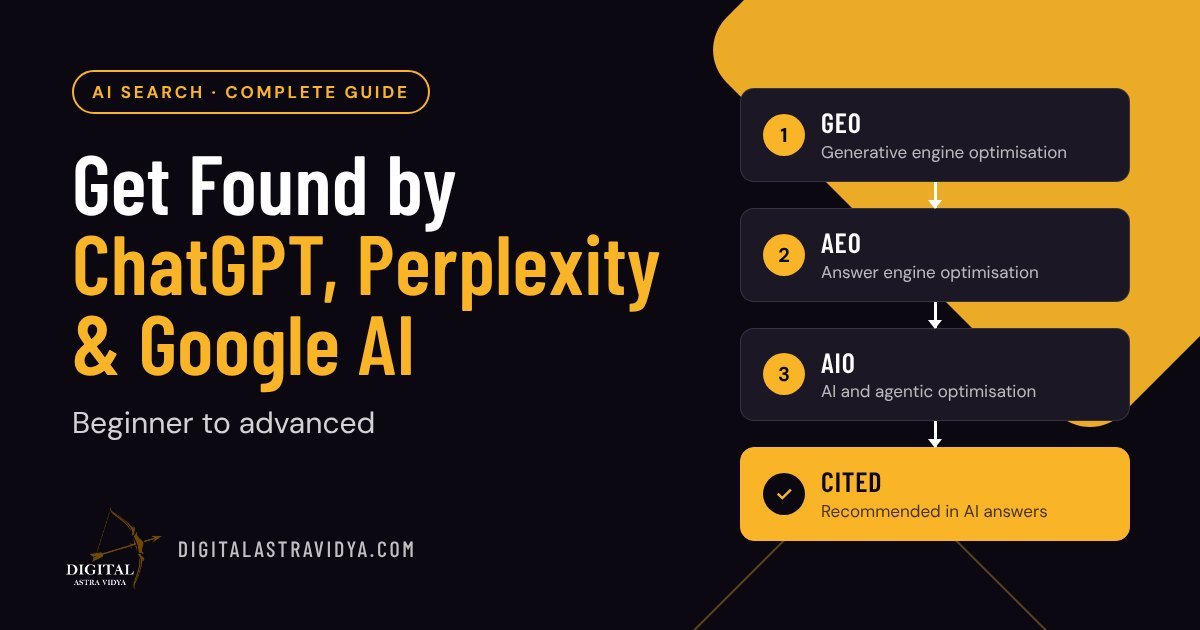
Short answer: To get found by ChatGPT, Perplexity, Gemini, Claude and Google’s AI Overviews and AI Mode, your brand has to be easy for AI to access, easy to understand, trusted enough to recommend, and present where buyers ask their questions. In practice, that means letting AI crawlers read your site, answering questions clearly with well-structured pages and schema, keeping your brand details consistent everywhere, earning genuine reviews and credible mentions, publishing original expert content (especially comparison and buying-decision content), and tracking your visibility every month.
Search now runs on two systems. One is the traditional list of ranked links. The other is AI tools that read many sources and combine them into one direct answer. In many cases the user never visits a website at all. The AI answer is the destination.
So the real question is no longer only “Do we rank?” It is “Does our brand appear when someone asks an AI tool about our category, and does the AI trust us enough to name, cite or recommend us?” This guide takes you from the basics to a complete action plan.
What changed this autumn (updated November 2026)
AI search moves fast. Three changes since October affect how brands in India get found in AI answers.
| Change | When | What it means for you |
|---|---|---|
| Ads in Google AI Mode are rolling out in India | Announced 28 October 2026 | AI answers now carry paid results too. Plan your organic and paid visibility in AI Mode together. |
| Google calls fake author profiles deception | Google guidance last updated 5 October 2026 | Made-up names, AI headshots and false credentials are now named as signs of a low-quality page. Real, detailed author pages matter more. |
| Microsoft Copilot now needs a sign-in | Semrush stopped tracking Copilot on 9 November 2026 | Some AI visibility tools can no longer measure Copilot. Test it yourself while signed in. |
How AI search works
AI tools draw on two sources when they answer a question.
- Training data: what the model learned before it was released. Brands that are discussed widely and consistently across the web are more familiar to the model.
- Live web retrieval: the tool searches the web in real time, reads pages and summarises them, often with citations.
Google’s AI Overviews and AI Mode use Google’s own index. Other tools, such as ChatGPT and Perplexity, use their own crawlers and search partners. Your visibility therefore depends on two things: your long-term brand footprint, and how well your pages perform when an AI searches in real time.
GEO, AEO and AIO: the three disciplines
You will see three terms used for this work. They overlap, but each has a different focus. For a simpler introduction, start with What Is AI Search Visibility?
| Discipline | Focus | Typical work |
|---|---|---|
| GEO (generative engine optimisation) | Getting your brand named, cited and recommended in AI answers | Brand mentions, reviews, expert content, consistent entity information |
| AEO (answer engine optimisation) | Structuring content so AI can lift a clean, direct answer | Answer-first writing, question headings, FAQs, tables, schema |
| AIO (AI and agent optimisation) | Making sure AI crawlers and agents can access, read and act on your site | Crawler access, fast clean pages, structured data, clear navigation and forms |
Put simply: AIO gets your site read, AEO gets your content used, and GEO gets your brand credited.
Mentioned vs cited: why the difference matters
Not all AI visibility is equal. There are four levels.
| Level | What it looks like | Business value |
|---|---|---|
| Absorbed | The AI repeats your idea but names nobody | Almost none |
| Mentioned | The AI names your brand | Awareness and trust; people may search for you |
| Cited | The AI names you and links to your page as a source | Awareness, traffic and a strong trust signal |
| Recommended | The AI suggests your brand as an option to choose | The closest thing to a referral, and the most valuable |
Your goal is to move from absorbed to mentioned, cited and recommended for the questions your buyers actually ask.
The three reasons brands go invisible to AI
| Problem | Symptom | What fixes it |
|---|---|---|
| 1. Understandability | The AI is unsure who you are, or describes you wrongly | Clear About and service pages, Organization and Person schema, the same name, description and details across all profiles |
| 2. Credibility | The AI knows you but prefers your competitors | Reviews, expert authors, original data, case studies, mentions on trusted industry and media sites |
| 3. Deliverability | You appear for your own name, but never for category questions | Content that answers category and buying questions, comparisons, presence on the platforms AI cites in your niche |
Fix them in this order. You cannot build credibility before the AI understands who you are, and it will not recommend you to new audiences before it trusts you.
Credibility now includes real authors. Google’s guidance on helpful content says that fabricating creator profiles, such as AI-generated headshots, made-up names or false credentials, is a form of deception. It also says AI content published without manual oversight or curation shows little or no effort. Show who wrote each page, what qualifies them, and link to a full author profile.
The AI resume test: check where you stand
Ask ChatGPT, Gemini, Perplexity, Claude and Google (AI Overviews and AI Mode) these five types of question about your business:
- Identity: “What is [brand]?” and “Who founded [brand]?”
- Offer: “What services does [brand] provide, and for whom?”
- Category: “Who are the best [service] providers in [city or niche]?”
- Comparison: “[Brand] vs [competitor]: which is better for [need]?”
- Problem: a real question a customer asks before buying.
Score each answer: 2 if you are recommended or cited accurately, 1 if you are mentioned or partly accurate, and 0 if you are missing or described wrongly. Note which websites the AI cites. Those are the sources it trusts in your category. Repeat the test every month and track your score.
Foundation 1: technical access
- Allow AI crawlers: check that robots.txt does not block crawlers such as GPTBot, OAI-SearchBot, ChatGPT-User, ClaudeBot, PerplexityBot and Google-Extended, and that your firewall or CDN is not blocking them either. If you want to block AI training without losing search visibility, see how the new AI training rule works.
- Be indexed in Google and Bing: set up Google Search Console and Bing Webmaster Tools, and submit your sitemap to both.
- Keep key content in the HTML: not only inside images, PDFs, click-to-open tabs or heavy scripts.
- Fast, mobile-friendly, secure pages: with clean, logical headings.
- Structured data: Organization, Person (for authors and founders), Service, Article and FAQPage schema.
- Optional llms.txt file: a short guide to your key pages for AI tools. It is a proposed convention, not an official standard, but it is quick to add.
Foundation 2: content AI can use
- Answer first: put a clear two- or three-sentence answer at the top of each page.
- Use real questions as headings: phrase them the way people ask AI tools.
- Use lists, steps and tables: for processes, comparisons and specifications.
- Show expertise: named authors with real credentials, first-hand examples, screenshots and results.
- Add original information: your own data, frameworks, pricing guidance and case studies that cannot be found elsewhere.
- Keep content fresh: update important pages and show the updated date.
Avoid the “bland tax”
AI tools recognise content that simply repeats what is already everywhere. They can summarise the idea without crediting anyone, so your brand disappears from the answer. The cure is specificity: your own examples, numbers, opinions, local context and named frameworks. Generic content produced quickly with AI makes this problem worse, not better. Learn more in How AI Tools Are Changing Content Marketing.
Foundation 3: your brand beyond your website
Much of what AI tools know about your brand comes from other websites, not your own.
- Consistent profiles: the same name, description, services, address and phone number on your Google Business Profile, LinkedIn company page, industry directories and social profiles.
- Reviews: genuine reviews on Google and on the platforms that matter in your industry.
- Credible mentions: industry publications, partner sites, “best of” lists, podcasts, events and local media.
- Communities and video: helpful answers in relevant communities, and explainer videos on YouTube.
- Founder visibility: a strong personal profile and expert commentary from the people behind the brand.
Topical ownership: why good content alone isn’t enough
Two equally good pages can be treated very differently, because AI tools also weigh who published them. A brand that covers a topic in depth, with connected articles, a recognised expert author and mentions from other sites, is treated as an authority far more readily than a site with one good page.
Build topic clusters: one main guide, linked to focused articles on each sub-topic, all linking back to each other, and written by a named expert.
The content priority shift: bottom-of-funnel wins
AI Overviews and chat tools now answer many broad beginner questions directly, so top-of-funnel content brings fewer clicks. Content close to a buying decision holds up better, and it is more likely to make an AI name specific brands. Prioritise:
- Comparisons: “X vs Y” and “best options for…” pages.
- Buying guides and checklists.
- Pricing explanations: what things cost and what drives the cost.
- Case studies: with real results.
- Detailed service pages: with genuine FAQs.
Keep your educational content for topical authority, but make your buying-stage pages excellent.
Paid visibility: ads inside AI answers
On 28 October 2026, Google announced that ads in AI Mode are now scaling in India, along with Australia, Canada, Kenya, Malaysia, New Zealand, Nigeria, Pakistan, the Philippines and Singapore. Ads are clearly labelled “Sponsored”.
Google’s help page explains how this works for advertisers:
- No new campaign needed: existing Search, Shopping and Performance Max campaigns are automatically eligible to show ads in AI Overviews and AI Mode.
- No separate control: you cannot target AI Overviews or AI Mode on their own, or opt out of them.
- Match types matter: AI Max, broad match, Shopping and Performance Max can match both direct and related questions. Exact and phrase match keywords show only when the query has direct commercial intent.
- No separate report: results from AI Overviews and AI Mode are included in your normal campaign totals, not shown on their own.
For most businesses, the practical step is simple. Make sure your conversion tracking is accurate and your Merchant Center feed is complete, because those signals decide whether your ads are chosen for AI answers.
How to measure AI search visibility
- AI resume test score: run it monthly across the main tools and your key prompts.
- AI referral traffic in Google Analytics 4: look for session sources such as chatgpt.com, perplexity.ai, gemini.google.com, copilot.microsoft.com and claude.ai.
- Branded search demand: track it in Google Search Console and Google Trends.
- Brand mentions: monitor mentions across the web, and which sources AI tools cite in your category.
- Leads that mention AI: add a “ChatGPT / AI tool” option to your “How did you hear about us?” question.
- Check Copilot manually: Microsoft now requires a sign-in to use Copilot, and Semrush stopped tracking Copilot visibility from 9 November 2026. Run your key prompts in Copilot yourself each month, signed in, and note whether your brand appears.
Your AI visibility checklist
- AI crawlers allowed, and your site indexed in Google and Bing.
- Organization, Person, Service and FAQ schema on key pages.
- Answer-first service pages with real FAQs.
- Consistent brand details across your website, LinkedIn, Google Business Profile and directories.
- A steady flow of genuine reviews.
- Expert content with original examples, organised in topic clusters, under real named authors.
- Comparison and buying-decision content.
- Monthly prompt testing and AI referral tracking.
Common mistakes to avoid
- Blocking AI crawlers by accident: often through security or firewall settings.
- Publishing generic, mass-produced AI content: it adds nothing an AI cannot already say.
- Inventing author profiles: Google now names this as deception.
- Inconsistent brand information: different names, descriptions or details across profiles.
- Focusing only on your website: and ignoring reviews and mentions elsewhere.
- Chasing tricks: hidden text or keyword-stuffed pages aimed at AI do not build lasting trust.
- Not measuring: without tracking, you cannot see progress.
Frequently asked questions
How do I get my business mentioned by ChatGPT?
Make sure AI crawlers can access your site, and describe your business clearly and consistently everywhere it appears. Publish expert content that answers real customer questions, and earn reviews and mentions on trusted sites. Track progress by asking ChatGPT relevant questions every month.
How do I appear in Google AI Overviews?
AI Overviews draw on Google’s index, so strong SEO is the foundation. Answer the question clearly near the top of the page, use lists and tables, show real expertise, and keep your content up to date.
What are GEO, AEO and AIO?
GEO (generative engine optimisation) is about being named and cited in AI answers. AEO (answer engine optimisation) is about structuring content so answers can be extracted. AIO (AI and agent optimisation) is about making sure AI crawlers and agents can access and use your site.
Does schema markup help with AI search?
Yes. Organization, Person, Service and FAQPage schema help machines understand who you are and what you offer. Schema supports visibility, but it works best alongside strong content and brand signals.
How long does it take to improve AI search visibility?
Technical fixes can show results within weeks. Building reputation, mentions and topical authority usually takes several months.
Can I advertise in Google AI Mode in India?
Yes. Google announced on 28 October 2026 that ads in AI Mode are scaling in India. Existing Search, Shopping and Performance Max campaigns are eligible automatically, and there is no separate setting to target or exclude AI Mode.
Explore further
- What Is AI Search Visibility? (beginner guide and self-test)
- What AI Search Visibility Means for Your Business: A Guide for Leaders
- How AI Tools Are Changing Content Marketing
- SEO vs SEM: What’s the Difference?
Sources
- Google: Ads in AI Mode expand to new markets (28 October 2026)
- Google Ads Help: About ads in AI-powered experiences in Google Search
- Google Search Central: Creating helpful, reliable, people-first content
- PPC Land: Semrush drops Copilot from AI visibility tracking on November 9 (29 October 2026)
Want an expert view of how AI tools see your brand, with a clear action plan? Book an AI Search Visibility Review, see our SEO & AI Search Visibility service, or learn GEO and AEO in our online training.