
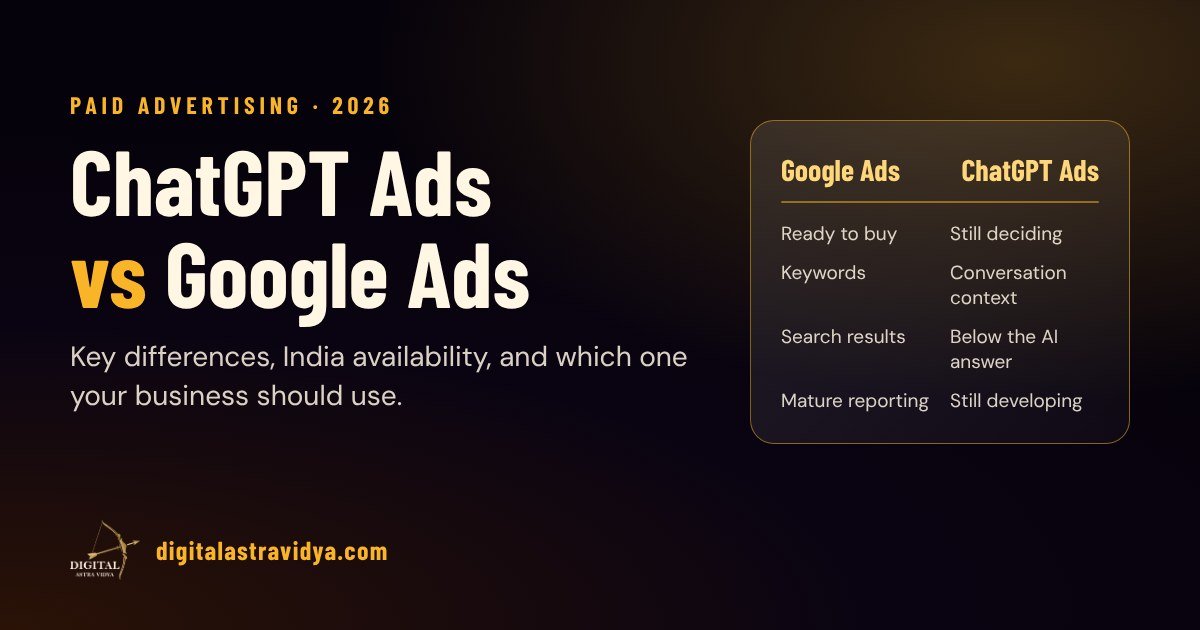
Short answer: Google Ads reaches people who are already searching for something and are often ready to act. ChatGPT Ads reach people earlier, while they are researching and comparing options in a conversation. For most businesses, Google Ads should stay the foundation, because its targeting and reporting are proven. ChatGPT Ads are worth a small, controlled test for businesses with considered purchases, such as B2B services, consulting, education and higher-value products. Self-serve ChatGPT Ads opened in India in late August 2026, so Indian advertisers can now try both.
Here is how the two platforms differ, what we know about ChatGPT Ads in India, and how to decide where your budget should go.
What ChatGPT Ads are
ChatGPT Ads are sponsored placements that appear below ChatGPT’s answer, clearly labelled as ads and kept separate from the answer itself. OpenAI says ads do not influence what ChatGPT recommends, and advertisers cannot see users’ private conversations. Ads are shown to users on the Free and Go plans; paid plans are ad-free.
ChatGPT Ads launched in February 2026, self-serve buying through Ads Manager followed in May 2026, and OpenAI expanded self-serve access to India, Europe, the Middle East and North Africa on 31 August 2026.
ChatGPT Ads vs Google Ads at a glance
| Google Ads (Search) | ChatGPT Ads | |
|---|---|---|
| Buyer intent | People searching to buy or act now | People researching and comparing, earlier in the journey |
| Targeting | Keywords, match types, negative keywords, location, audiences | Conversation context, custom audiences, product feeds, location; no keyword lists |
| Where ads appear | Top and bottom of search results | Sponsored cards below the AI answer |
| Who sees them | Everyone using Google Search | ChatGPT Free and Go users only |
| Pricing | Cost per click (CPC) bidding | Cost per click or cost per 1,000 impressions (CPM) |
| Measurement | Mature: Google Ads conversion tracking and GA4 | Newer: OpenAI’s measurement pixel and Conversions API, still developing |
| Track record | More than 25 years | Launched in 2026; formats and tools still changing |
The 5 differences that matter most
1. Intent: “ready to buy” vs “still deciding”
Someone who searches “digital marketing course online fees” on Google usually knows what they want. Someone who asks ChatGPT “how do I choose a digital marketing course that fits my job?” is still working it out. Google Ads capture existing demand; ChatGPT Ads help you get into the shortlist earlier. This is similar to the difference between paid search and paid social, which we cover in Paid Search vs Paid Social.
2. Targeting: keywords vs context
Google gives you precise control through keywords, match types and negative keywords. ChatGPT does not use keyword lists. It matches ads to the topic of the conversation, along with audiences, product feeds and location. You get less control over exactly when your ad appears, so your message has to be clear and relevant.
3. Format: results page vs inside the conversation
Google ads link to your website from a page of results. ChatGPT ads appear as a sponsored card after the answer, and users may continue the conversation instead of clicking. Your landing page still matters, but so does how clearly the ad explains your offer in a few words.
4. Measurement: proven vs still developing
Google Ads and GA4 give detailed conversion reporting. ChatGPT Ads reporting is newer. Early benchmarks reported by industry publications suggest lower click-through rates than Google Search ads, but the data is limited and changes quickly, so treat any figures as a rough guide. Track assisted conversions, growth in branded searches and enquiries, not just last-click sales.
5. Maturity: stable vs fast-changing
Google Ads features are well documented and stable. ChatGPT Ads formats, bidding options and eligibility are changing month to month. Check OpenAI’s current Ads Manager documentation before you plan a budget.
Which should your business use?
| Your business | Recommended approach |
|---|---|
| Local services and quick leads (clinics, salons, repairs, real-estate site visits) | Google Ads first. People search with clear, local, ready-to-act intent |
| Ecommerce | Google Ads (Search and Shopping) first. Test ChatGPT with a product feed once your Google campaigns are profitable |
| B2B, consulting and professional services | Google Ads plus a small ChatGPT test, to appear while buyers are still researching |
| Education, courses and training | Google Ads for “course” searches; a ChatGPT test for “which course should I choose?” conversations |
| Small budget | Focus on Google Ads and strong SEO first. A small budget split across two platforms rarely gives clear results |
How to run a sensible ChatGPT Ads test
- Get Google Ads working first. Make sure conversion tracking in Google Ads and GA4 is accurate and campaigns are profitable.
- Set a fixed test budget. Use a small share of your monthly ad spend for 4 to 6 weeks.
- Pick one clear offer. For example, a free consultation, a course enquiry or one hero product.
- Install measurement. Add OpenAI’s measurement pixel or Conversions API, and tag your landing page links with UTM parameters so the traffic shows up separately in GA4.
- Write for a conversation. Answer the question the user is likely asking, in plain language, rather than writing a keyword-style headline.
- Judge it fairly. Compare cost per lead, lead quality and any lift in branded searches and direct enquiries, not just clicks.
Don’t forget organic AI visibility
Ads are only one way to appear in ChatGPT. Its normal answers recommend businesses based on their websites, reviews and mentions across the web, and you cannot buy your way into those. Since November 2026, businesses can also claim their profile in ChatGPT; see Businesses in ChatGPT: What OpenAI Launched and What to Do Now. For the full picture, read AI Search Visibility: The Complete Guide.
Frequently asked questions
Are ChatGPT Ads available in India?
Yes. ChatGPT ads arrived in India in late August 2026, and OpenAI announced self-serve buying through Ads Manager for India, Europe, the Middle East and North Africa on 31 August 2026. Features and eligibility are still changing, so check Ads Manager for the current options.
Are ChatGPT Ads better than Google Ads?
Not better, different. Google Ads reach people who are actively searching and ready to act, with mature targeting and reporting. ChatGPT Ads reach people earlier, while they research and compare. Most businesses should keep Google Ads as the foundation and test ChatGPT Ads with a small budget.
Do ChatGPT Ads change ChatGPT’s answers?
No. OpenAI says ads are clearly labelled, shown separately below the answer, and do not influence what ChatGPT recommends.
Who sees ads in ChatGPT?
Users on the Free and Go plans. Paid plans are ad-free, and OpenAI excludes accounts under 18 and avoids showing ads next to sensitive topics.
How do I measure ChatGPT Ads?
Use OpenAI’s measurement pixel or Conversions API, tag your links with UTM parameters for GA4, and track cost per lead, lead quality and branded search growth alongside clicks.
Related reading
- Paid Search vs Paid Social: Which Should You Choose?
- Google Ads Channel Prioritization
- SEO vs SEM: What’s the Difference?
- Businesses in ChatGPT: What to Do Now
Need help deciding where your ad budget should go? See our Google Ads & Meta Ads management service, or learn paid advertising hands-on in our live online training.
Sources
- Expanding access to AI with ChatGPT ads, OpenAI
- OpenAI expands ChatGPT Ads self-service access to India and Europe, Unite.AI
- ChatGPT ads arrive in India, Business Today
- ChatGPT Ads vs Google Ads: key differences, Search Engine Land
- ChatGPT Ads vs Google Ads, WebFX