
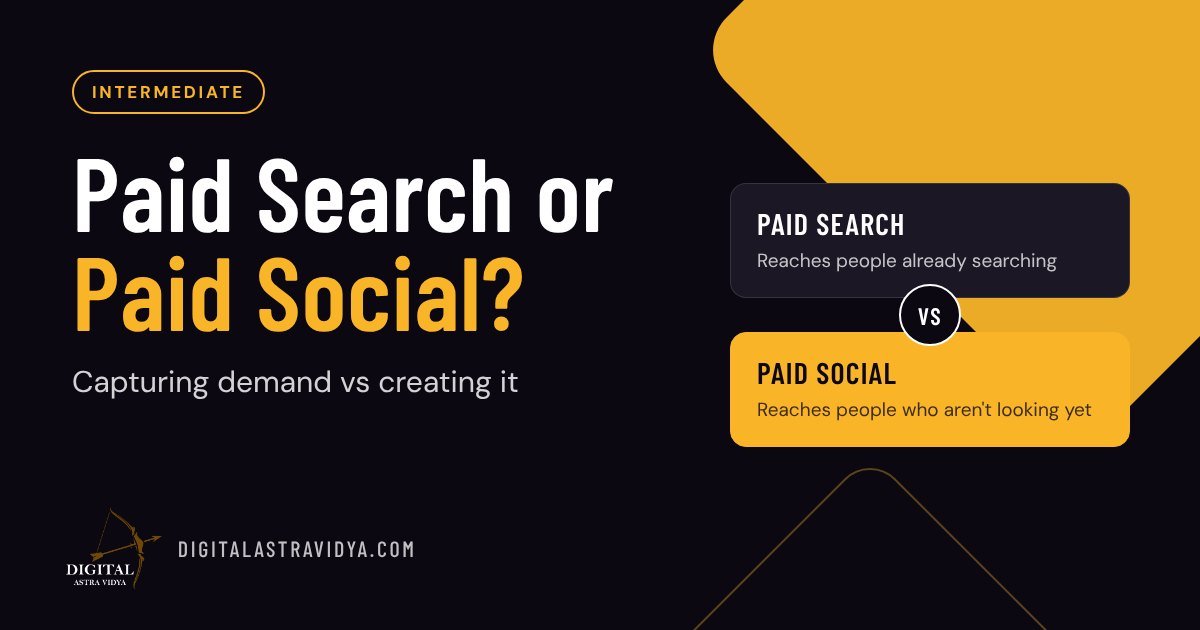
Short answer: Choose paid search (Google Ads, Microsoft Ads) when people are already searching for what you sell: it captures existing demand at the moment of intent. Choose paid social (Meta, Instagram, LinkedIn, YouTube ads) when you need to create demand, show something visually or reach a specific audience before they start searching. Most growing businesses end up using both: social to create interest, search to capture it.
Once a business is ready to invest in advertising, one of the first big decisions is where to put the budget. Both channels can work brilliantly, but they work in fundamentally different ways. Pick the wrong one for your situation and you waste budget, however well the campaign is run.
The core difference: intent vs interruption
Paid search shows your ad to people who are actively searching right now. Someone typing “emergency plumber near me” or “digital marketing course online” has a clear, immediate need. You meet them at the moment of demand.
Paid social shows your ad to people based on who they are and what they are interested in, not what they are searching for. Someone scrolling Instagram isn’t looking for a plumber. A good social ad has to stop the scroll and create interest that wasn’t there a moment ago.
This one distinction, capturing demand vs creating demand, should drive most of your decision.
Paid search vs paid social at a glance
| Paid search | Paid social | |
|---|---|---|
| Platforms | Google Ads, Microsoft Ads, YouTube search | Facebook, Instagram, LinkedIn, YouTube, X |
| Targets by | Keywords: what people search for | Audience: location, age, interests, job role, behaviour, lookalikes |
| User mindset | Looking for a solution now | Browsing, not looking to buy |
| Main job | Capture existing demand | Create demand and awareness |
| Ad format | Mostly text, plus shopping and video | Images, videos, reels, carousels |
| Typical cost | Higher cost per click, but higher intent | Lower cost per click or view, but colder audience |
| Speed to leads | Fast, if people search for your offer | Usually needs more creative testing |
| Limit | Can’t reach people who aren’t searching | Creative wears out; needs fresh ads regularly |
When paid search makes more sense
- People actively search for what you offer: services, specific products or solutions to a known problem.
- There is a clear way people describe the need, such as “tax accountant Mumbai” or “buy running shoes online”.
- You need leads quickly and have a page ready to convert them.
- Urgent or high-value services: repairs, healthcare, legal, education, B2B software.
The trade-off: if few people search for your offer, because it is new or people don’t yet know they need it, paid search has little demand to capture. See SEO vs SEM for how paid and organic search work together.
When paid social makes more sense
- Your product is visual, and seeing it creates interest: fashion, food, home decor, travel, design.
- You are introducing something new that people aren’t searching for yet.
- You can define your audience precisely, for example HR managers in Bengaluru or new parents in Pune.
- You want to build awareness and retarget people over several touches before they buy.
- You sell impulse or lifestyle products with a strong visual hook.
The trade-off: because you are creating interest rather than capturing it, paid social usually needs more creative testing and a longer runway before it converts efficiently.
Which platform within each channel?
- Google Ads: the default for search intent. Performance Max and Demand Gen campaigns also reach YouTube, Gmail and Discover. See Google Ads Channel Prioritization.
- Meta Ads (Facebook and Instagram): broad consumer reach, strong for e-commerce, local businesses, education and lead forms. Click-to-WhatsApp ads work very well in India.
- LinkedIn Ads: expensive per click, but unmatched targeting by job title, company and industry for B2B.
- YouTube Ads: best for demonstrations, explainers and building familiarity at scale.
Using both together: the full-funnel approach
The two channels aren’t rivals. They work at different stages of the marketing funnel:
- Paid social creates awareness among the right audience with videos and reels.
- Retargeting ads on social bring back people who engaged or visited your site.
- Paid search captures them when they later search for your category or your brand name.
This is why a business can see branded searches rise after a social campaign, even if the social ads themselves got few direct sales. Measure both channels together, not in isolation. See Understanding Attribution Models.
A simple decision framework
Ask these four questions:
- Are people already searching for what I sell? Check Google Keyword Planner. If yes, start with search.
- Is my product easier to show than to describe? If yes, social has an advantage.
- Do I know exactly who my buyer is (job role, life stage, interests)? Social can target them directly.
- How quickly do I need results? Search usually delivers faster when demand exists.
Whichever you choose, start with one channel, one clear goal and enough budget to collect data, then expand. Make sure tracking is in place first: see How to Read a Google Analytics Dashboard.
Real examples
A new ergonomic chair brand (social first)
Almost nobody searches for “ergonomic standing-desk hybrid chair” yet, because the category is unfamiliar. Paid search alone has little to target. Instagram and YouTube videos showing the chair in use reach people interested in home offices and productivity. As awareness grows, people start searching for the brand by name, and a small branded search campaign captures them cheaply.
A CA firm in Mumbai (search first)
People actively search “GST registration consultant Mumbai” and “ITR filing CA near me”, especially before deadlines. A Google Ads search campaign targeting these keywords, sending visitors to a dedicated landing page, brings enquiries within days. Later, LinkedIn ads targeting business owners build the firm’s reputation for higher-value advisory work.
Common mistakes to avoid
- Running search ads for something nobody searches for, then concluding “Google Ads doesn’t work”.
- Judging social ads only by last-click sales, ignoring the awareness and branded searches they create.
- Using the same ad everywhere. Search needs ads that match the query; social needs thumb-stopping visuals.
- Sending all traffic to the homepage instead of a focused landing page.
- Spreading a small budget across too many platforms so none gets enough data.
Frequently asked questions
Is Google Ads better than Facebook Ads?
Neither is better in every case. Google Ads is usually better when people actively search for your product or service. Facebook and Instagram Ads are usually better for visual products, new categories and reaching specific audiences before they search.
Which is cheaper, paid search or paid social?
Paid social often has a lower cost per click, but paid search clicks usually come from people with higher intent. Compare cost per lead or cost per sale, not cost per click.
Should a small business start with paid search or paid social?
If customers already search for your service, start with paid search. If your product is visual or new, start with paid social. With a small budget, focus on one channel until it works.
Can I run paid search and paid social together?
Yes, and many businesses should. Social builds awareness and interest, and search captures people when they are ready to act. Measure them together to see the full effect.
What budget do I need to test a channel?
Enough for the campaign to gather meaningful data, usually several weeks of steady spend on one clear goal. Start small, track cost per result, then scale what works.
Related reading
- What Is Performance Marketing?
- Social Media Marketing for Beginners
- SEO vs SEM: What’s the Difference?
- Building a Full-Funnel Measurement Strategy
Want expert help planning your ad budget? See our Performance Marketing service, or learn Google and Meta Ads hands-on in our online digital marketing training, available as one-on-one or group classes.