
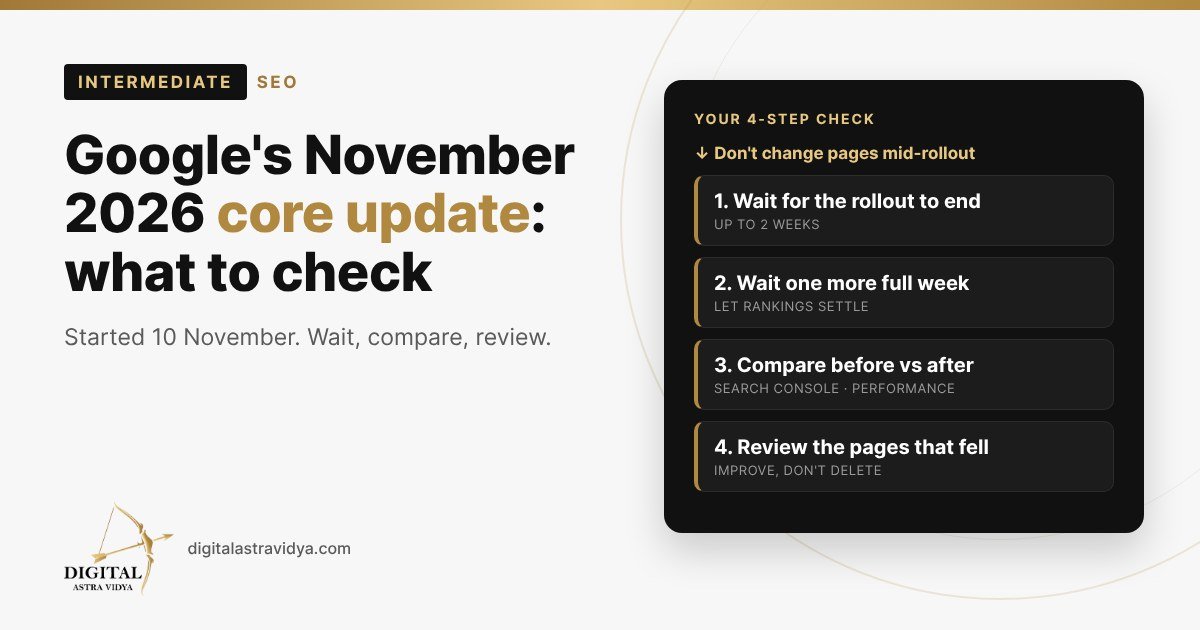
Short answer: Google rolled out the November 2026 core update from 10 November to 24 November 2026, about 14 days. It applied to all countries and all languages. If your traffic moved, compare a full week after 24 November with the week before 10 November in Google Search Console before you change anything. Google has also pre-announced another core update for December 2026.
Update, 25 November 2026: Google confirmed the rollout was complete on 24 November 2026. We have added the end date and what we know about the December 2026 core update.
Imagine you run an online home décor store in Mumbai. On Wednesday your clicks from Google dip. By Friday they are back up, and a different set of pages is ranking. During a core update, this kind of swing is normal.
A core update is a broad change to how Google ranks pages. It is not a penalty, and it does not target single sites. So your first job is to measure calmly, not to rewrite your website.
“In my 14 years in SEO, I have seen many core updates. Most of the sites that took a hit had thin or outdated content. Content is still what decides who holds up, and today it also decides whether you appear in AI search answers.” — Nilesh Malpure
What Google has confirmed about this update
Google announced the update on its Search Status Dashboard. Here is everything Google has confirmed so far.
| Detail | What Google says |
|---|---|
| Start | 10 November 2026, 10:06 a.m. US Pacific time (11:36 p.m. India time) |
| Where it applies | Globally, in all languages, including Hindi, Marathi and other Indian languages |
| End | 24 November 2026, 6:03 a.m. US Pacific time (7:33 p.m. India time). Google: “The rollout was complete as of November 24, 2026” |
| How long | About 14 days, within Google’s estimate of “up to 2 weeks” |
| What it targets | Nothing specific. Core updates “don’t target specific sites or individual web pages” |
| When to check your data | At least a full week after the rollout completes, so from 1 December 2026 |
On LinkedIn, Google’s Search Central team called it “a regular update designed to better surface relevant, satisfying content for searchers from all types of sites”, as reported by Search Engine Journal. Google has not named any new ranking factor.
Tip: Many older guides tell you to act the day an update starts. Google’s own advice is the opposite: wait for the rollout to finish.
Why rankings move during a core update
Google makes broad core updates several times a year. Each one changes how its systems judge the overall usefulness of pages.
That means a page can drop without doing anything wrong. Often, other pages are now judged more helpful for the same search. Your page did not get worse; the competition got reassessed.
Rankings also move up and down while the update rolls out. Data from the middle of a rollout is not a fair picture of where you will land.
How to check your site in Search Console
Use this process once the rollout is complete.
- Note the end date. The rollout finished on 24 November 2026, as shown on the Google Search Status Dashboard.
- Wait a full week. Google recommends waiting at least one full week after completion before you analyse anything.
- Set up a date comparison. In Google Search Console, open Performance, then Search results. Open the Date filter (or click New), choose Compare, and set the week after completion against the week before 10 November. Click Apply.
- Read the Difference column. Search Console shows a Difference column for each row. Check the Queries and Pages tabs to see which searches and pages moved.
- Check each search type. Switch between Web, Image, Video and News. A drop may sit in only one of them.
- Decide how big the change is. A small dip and a large, lasting fall need very different responses (see the table below).
| What you see | What it usually means | What to do |
|---|---|---|
| A small drop of a few positions | Normal movement after an update | No drastic action. Do not change pages that still perform well |
| A large drop across many pages | Google now prefers other pages for those searches | Review the site as a whole and the most affected pages |
| A drop in only one search type | The change sits in images, video or news | Focus your review on that content type |
| A gain | Your pages were judged more helpful | Keep doing what works; do not rewrite winning pages |
What to do if you lost traffic
Start with Google’s helpful content questions. Ask them about your most affected pages, honestly:
- Original value: “Does the content provide original information, reporting, research, or analysis?”
- Worth sharing: “Is this the sort of page you’d want to bookmark, share with a friend, or recommend?”
- Expertise: “Is this content written or reviewed by an expert or enthusiast who demonstrably knows the topic well?”
Google also suggests thinking about who, how and why. Show who wrote the page with a real byline. Explain how it was made, including any substantial use of AI. And make sure the main reason the page exists is to help people, not to attract search traffic.
Then make lasting improvements, not quick fixes. Google calls deleting content “a last resort”.
Be patient with results. Some changes take effect in days, but Google says it can take several months for its systems to recognise that a site has improved. Sometimes you need to wait for the next core update.
An example
Say a coaching institute in Nagpur sees clicks to its course pages fall after 10 November.
The owner waits until the dashboard shows the rollout is complete. A week later, she compares that week with 3 to 9 November in Search Console. The drop is mostly on three short city pages that only repeat “best coaching in Nagpur”.
Instead of deleting her blog, she improves those three pages. She adds real fee ranges, batch timings, faculty details and honest answers to the questions parents ask. Her guides that still rank stay untouched.
What comes next: the December 2026 core update
About an hour after the November update finished, Google posted a new entry on its Search Status Dashboard. It says another core update is “scheduled to be released in December 2026”.
This is unusual. Google normally announces a core update only when it starts. Google gave no exact start date, and told Search Engine Roundtable the launch is “not imminent”.
Google says the December update will bring:
- Better handling of complex searches: improvements to how its systems understand and rank content for longer, more detailed questions.
- More personalised results: only for people who have personalisation turned on.
What it means for you: the December update may arrive before you can see the full effect of the November one. Note both rollout dates in your reports, so you know which update a change belongs to. Pages that answer detailed questions clearly and completely are well placed for both.
Common mistakes to avoid
- Reacting mid-rollout: changing pages while rankings are still moving makes it impossible to see what helped.
- Comparing the wrong weeks: festive-season traffic around Diwali, and Black Friday sales for ecommerce sites, can distort a before-and-after comparison. Also compare with the same weeks last year.
- Deleting content in bulk: removing pages rarely fixes quality on its own. Google treats deletion as a last resort.
- Rewriting pages that still rank: Google advises against changing content that is already performing well.
- Blaming the update for a tracking problem: if Google visits show up as “direct” or “referral” in your analytics, check your tags and channel rules first. Google published a guide to identifying Google Search traffic on 12 November 2026.
Frequently asked questions
When did the Google November 2026 core update start?
It started on 10 November 2026 at 10:06 a.m. US Pacific time, which was 11:36 p.m. in India. Google announced it on the Search Status Dashboard.
When did the November 2026 core update finish?
Google confirmed the rollout was complete on 24 November 2026, about 14 days after it started on 10 November.
Is a Google core update a penalty?
No. Core updates are broad changes that do not target specific sites or pages. A drop usually means other pages are now judged more helpful for the same searches.
Should I change my website during the rollout?
No. Wait until the rollout is complete, then wait at least another full week before you analyse your Search Console data.
How long does it take to recover from a core update?
It varies. Google says some improvements show up within days, but it can take several months for its systems to recognise them, and sometimes you need to wait for the next core update.
Related reading
- SEO vs SEM: What’s the Difference?
- How to Read a Google Analytics Dashboard
- AI Search Visibility: The Complete Guide to Getting Found by ChatGPT, Perplexity and Google AI
- What AI Search Visibility Means for Your Business
Sources
- November 2026 core update, Google Search Status Dashboard, 10 November 2026
- Google Search’s core updates, Google Search Central, updated 10 December 2025
- Creating helpful, reliable, people-first content, Google Search Central, updated 5 October 2026
- Performance report: advanced filtering and comparison, Google Search Console Help
- Identify traffic from Google Search, Google Search Central, added 12 November 2026
- Google’s November 2026 Core Update Starts Rolling Out, Search Engine Journal, 10 November 2026
- Google Confirms November 2026 Core Update Is Complete, Search Engine Journal, 24 November 2026
- Google November 2026 Broad Core Update Is Done Rolling Out, Search Engine Roundtable, 24 November 2026
- Google announces its December 2026 core update before it even starts, MACCUS, 24 November 2026
Want an expert check of what this update did to your traffic? Book an SEO and AI search visibility review, or learn to read Search Console yourself in our online digital marketing training, available as one-on-one or group classes.