
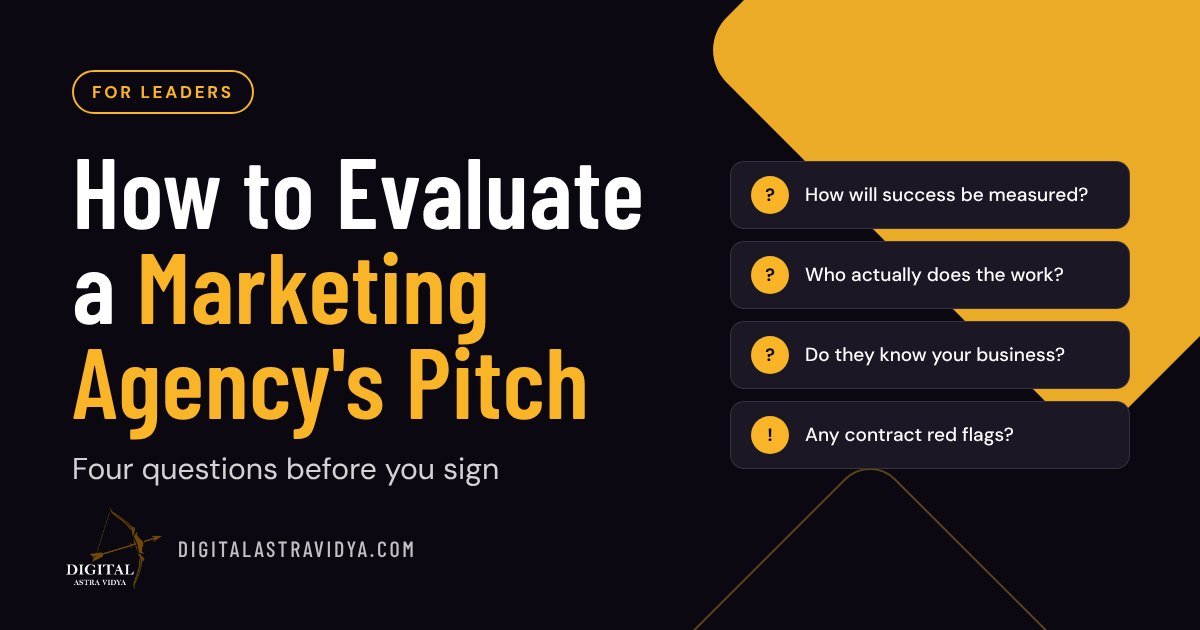
Short answer: To evaluate a marketing agency’s pitch, look past the polished deck and score every agency on the same criteria: how they will measure success, who will actually do the work, how well they understand your business, proof from real clients, transparency on pricing and ad spend, and fair contract terms, including you owning your ad accounts, data and creative. Be wary of guaranteed rankings or results, vague reporting and long lock-ins. A modest pitch with a clear measurement plan usually beats an ambitious one without it.
Most executives judge agency pitches on the wrong things: an impressive deck, a slide full of client logos and confident talk about “growth”. But a pitch is itself a marketing exercise, and agencies are naturally good at marketing themselves. This guide gives you a practical framework, the questions to ask and the red flags to watch for, so you can choose a partner that will actually deliver.
Before the pitch: prepare a clear brief
You will get better pitches, and fairer comparisons, if every agency answers the same brief:
- Business goal: for example, “increase qualified enquiries by 40% in 12 months”.
- Current situation: channels you use, rough budget, results so far and what has not worked.
- Scope: which services you need (SEO, Google Ads, Meta Ads, social media, content, analytics).
- Budget range: both agency fees and media (ad) spend.
- Decision criteria and timeline, shared with every agency in advance.
The agency pitch scorecard
Score each agency from 1 to 5 on these criteria, and agree the weights with your team before the pitches begin:
| Criterion | What good looks like | Suggested weight |
|---|---|---|
| Understanding of your business | Specific insights about your customers, competitors and current marketing, not a generic template | 20% |
| Strategy and approach | A clear plan linked to your goal, with priorities and reasoning | 20% |
| Measurement and reporting | Defined KPIs, realistic targets, tracking setup and a reporting rhythm | 20% |
| Team and expertise | You meet the people who will actually work on your account | 15% |
| Proof and references | Relevant case studies and current clients willing to speak to you | 10% |
| Commercials and contract | Transparent fees, fair notice period, you own all accounts and assets | 15% |
1. Ask how they will measure success, before you sign
A credible agency can explain what success looks like in specific, measurable terms: which metrics, over what timeframe, and a realistic range of outcomes for your industry and budget. Vague promises such as “we’ll drive growth” or “we’ll build your brand presence” are a warning sign.
- Which KPIs will you report on, and how do they link to revenue or leads?
- How will you set up and check tracking (GA4, conversion tracking, CRM)?
- How often will we get reports, and will we have live dashboard access?
Good agencies focus on business outcomes such as qualified leads, sales and cost per customer, not just clicks, impressions or follower counts. See Full-Funnel Measurement Strategy.
2. Find out who actually does the work
A common pattern: senior people present the pitch, then hand day-to-day work to junior staff you never meet. That is normal agency practice, but you should know it upfront.
- Who will work on our account day to day, and what is their experience?
- How much senior strategy time is included each month?
- Is any work outsourced or white-labelled to another company?
- How do you use AI tools, and who reviews the output?
3. Check how well they understand your business
A strong pitch shows real diagnostic work: your competitors, your customers, what your website and campaigns are doing well and badly. If a pitch could be used almost word for word for a completely different business, the agency has not done its homework.
4. Ask about retention and references, not just case studies
Case studies are the agency’s best results, so they are naturally selective. Better questions:
- What is your average client relationship length?
- Can we speak to a current client in a similar industry or of a similar size?
- Can you share a project that did not go well, and what you learned?
Agencies with strong retention are usually happy to arrange reference calls. Hesitation is worth noting.
5. Understand the pricing model
| Model | How it works | Watch out for |
|---|---|---|
| Monthly retainer | Fixed fee for an agreed scope | Vague scope that leads to extra charges |
| Percentage of ad spend | Fee is a share of your media budget | An incentive to increase spend rather than improve results |
| Project fee | Fixed price for a defined project | Unclear deliverables and revision limits |
| Performance-based | Fee linked to leads, sales or targets | How “results” are defined and tracked |
Always ask whether ad spend is paid directly by you to Google and Meta, or through the agency, and whether any markup is added.
6. Check the contract carefully
- Ownership: your ad accounts, Google Analytics, Search Console, website, domain, social pages, creative and data must belong to your business, with the agency given access, not the other way round.
- Notice period and lock-in: avoid long lock-ins before you have seen results. A short notice period, or a trial period, is fairer.
- Scope of work: clearly listed deliverables, revisions and response times.
- Handover: what the agency must hand over if the relationship ends.
- Confidentiality and data protection, especially for customer data.
Red flags to watch for
- Guaranteed rankings (“number 1 on Google”) or guaranteed results. Nobody can guarantee Google rankings.
- Refusing to share how they work, calling their methods “secret”.
- Creating ad accounts in their own name and not giving you admin access.
- Cheap backlink packages, fake followers or bought reviews. These can damage your brand and rankings.
- Reports full of vanity metrics with no link to leads or revenue.
- Pressure to sign quickly with discounts that expire.
- No questions about your business before presenting a solution.
A useful reframe
Instead of asking “does this pitch sound impressive?”, ask: “If this engagement fails to deliver in six months, will we be able to see clearly why?” An agency that sets up measurement, reporting and accountability from the start is showing real confidence in its work. One that avoids specifics is often protecting itself.
Consider a paid pilot
For larger engagements, ask for a short paid pilot (for example, an audit plus 60 to 90 days of work on one channel) before committing to a long contract. You see how the team works, communicates and reports, and the agency gets time to prove itself.
A real example
A retail company compares two agency pitches. Agency A shows an ambitious growth projection with little detail on how it was calculated. Agency B shows a more modest forecast, a clear measurement plan, a monthly reporting format, the names of the people on the account, and three specific problems it found in the company’s current Google Ads and website.
Agency B’s pitch is less exciting, but it is the stronger sign of a partner that will deliver honest, accountable work. The company chooses Agency B with a three-month pilot, keeps admin ownership of all accounts, and reviews results against the agreed KPIs before extending the contract.
Frequently asked questions
What questions should I ask a marketing agency before hiring?
Ask how they will measure success, who will work on your account, how they understand your business, what results they have achieved for similar clients, how they charge, who owns the ad accounts and data, and what the notice period is.
Should I trust an agency that guarantees results?
Be very careful. Nobody can guarantee Google rankings or exact results. Credible agencies give realistic ranges based on your budget and market, and explain the assumptions.
Who should own the Google Ads and Meta ad accounts?
Your business should. The agency should be given access to accounts you own, so you keep all data, history and assets if you change agencies.
How long should a marketing agency contract be?
It depends on the work, but avoid long lock-ins before seeing results. A trial or pilot period followed by a contract with a reasonable notice period protects both sides.
Should I hire an agency or an independent consultant?
Agencies offer a larger team and capacity; independent consultants or advisors often offer more senior attention and flexibility. An independent advisory review can also help you write the brief and evaluate agency pitches objectively.
Related reading
- 5 Signs Your Business Needs a Digital Advisory Review
- What to Expect From a Digital Advisory Engagement
- What AI Search Visibility Means for Your Business
- Marketing Attribution Models Explained
Choosing an agency or reviewing one you already use? Our Digital Advisory service offers an independent review of agency proposals, budgets and performance.