
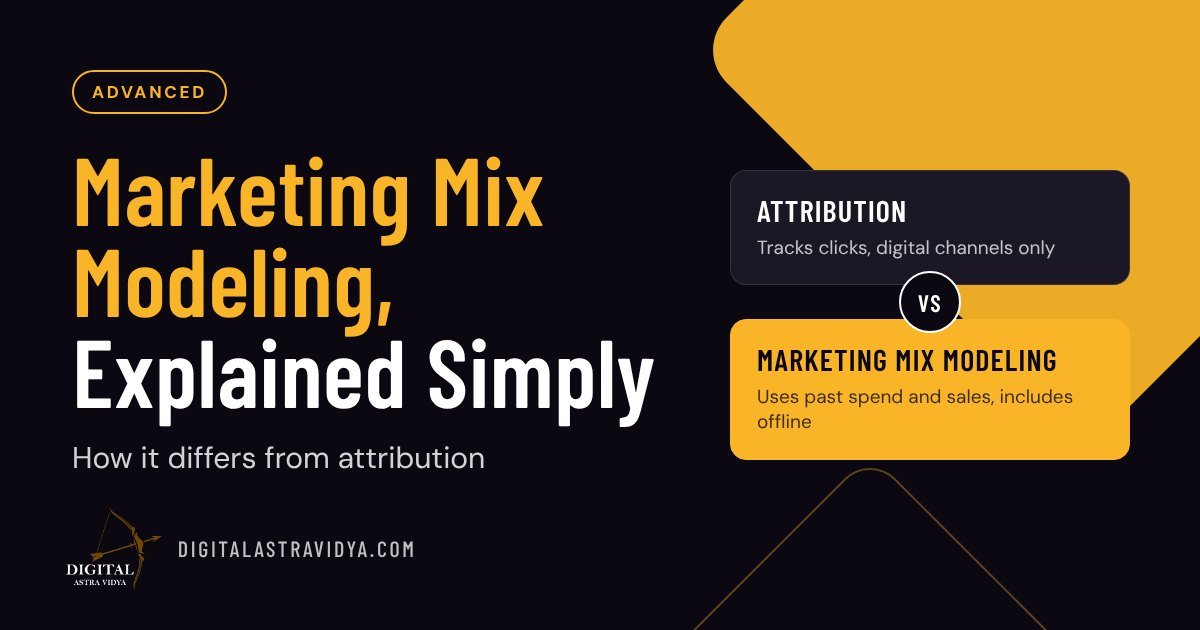
Short answer: Marketing mix modelling (MMM) is a statistical method that uses historical data, such as weekly spend on each channel alongside sales, to estimate how much each marketing channel really contributes to results. Unlike attribution, it does not track individual users, so it can measure offline channels like TV and print, still works when tracking is limited by privacy rules, and helps decide how to split budget across channels. Free open-source tools such as Google’s Meridian and Meta’s Robyn have made it far more accessible.
As a business grows, one question gets harder to answer: which channels are actually driving results, and how much should we spend on each? This guide explains MMM in plain language: how it works, what it needs, how it compares with attribution, and whether it makes sense for your business.
Why MMM exists alongside attribution
Digital attribution follows individual user journeys using clicks, cookies and tracking pixels. It is useful, but it has real blind spots:
- Offline channels: it cannot measure TV, radio, print, hoardings, events or word of mouth.
- Privacy and tracking limits: consent requirements, iOS tracking prompts and ad blockers mean many journeys are invisible.
- Brand effects: the slow-building impact of consistent advertising rarely shows up as a direct click.
- Credit vs cause: attribution shows which channels people touched, not whether those channels actually caused the sale.
MMM takes a different approach. It analyses aggregate data over time, with no individual tracking at all, which also makes it privacy-friendly.
MMM vs attribution at a glance
| Attribution | Marketing mix modelling | |
|---|---|---|
| Data used | Individual clicks and user journeys | Weekly or monthly totals: spend, sales and other factors |
| Channels covered | Mainly trackable digital channels | All channels, online and offline |
| Privacy impact | Depends on cookies, consent and tracking | No personal data needed |
| Best for | Day-to-day optimisation: ads, keywords, creatives | Strategic budget planning across channels |
| Speed | Near real time | Usually updated monthly or quarterly |
| Data needed | Tracking set up correctly | Often two years or more of weekly data |
How MMM works, in simple terms
MMM looks for patterns such as: in weeks when TV or YouTube spend increased, did sales rise more than usual, after accounting for seasonality, festivals, price changes and promotions? With enough history across many channels, a model can estimate each channel’s likely contribution.
Four ideas sit at the heart of every MMM:
- Baseline: the sales you would get with no marketing at all, from brand strength, repeat customers and word of mouth.
- Incremental contribution: the extra sales each channel adds on top of the baseline.
- Adstock (carry-over): advertising keeps working after it stops. A TV campaign this week can still lift sales weeks later.
- Saturation (diminishing returns): each extra rupee in a channel brings less than the one before. Doubling spend rarely doubles results.
The model also accounts for external factors such as seasonality, Diwali and other festivals, competitor activity, pricing, distribution and the economy, so marketing isn’t given credit for sales it didn’t drive.
What MMM tells you
- Contribution by channel: for example, “paid search drove about 20% of incremental sales and TV about 15%” (illustrative figures).
- Return on investment (ROI) by channel: how much revenue each rupee in each channel produced.
- Response curves: where each channel starts to saturate, showing when extra spend stops paying off.
- Budget scenarios: “What happens if we move 10% of budget from display to YouTube?” Many MMM tools include a budget optimiser.
What MMM needs to be useful
- Enough history: often two years or more of weekly data, so the model can separate marketing effects from seasonality.
- Spend that varies: if a channel’s budget never changes, the model has little to learn from.
- Clean, consistent data: spend, impressions, sales, prices, promotions and key external events, all by week.
- Statistical skill: building, checking and interpreting models needs analytics or data science experience.
- A meaningful budget across several channels: MMM adds most value when you spend across many channels, including offline.
Open-source tools have made MMM more accessible
MMM used to require expensive consultants. Today, free open-source frameworks lower the barrier for analytics teams:
- Meridian by Google
- Robyn by Meta
- PyMC-Marketing, a community-built Python library
These still need someone comfortable with data and statistics, but they make MMM realistic for many mid-sized brands, not just the largest advertisers.
Making MMM more reliable: calibrate with experiments
MMM finds correlations in historical data, so it works best when checked against real-world tests:
- Geo tests: run or increase a campaign in some cities but not others, then compare results.
- Lift studies: platforms such as Google and Meta offer conversion lift tests that compare people who saw ads with a control group.
- Holdouts: pause a channel briefly in a controlled way to see what really changes.
Feeding these results back into the model makes its estimates much more trustworthy.
Using MMM and attribution together
They answer different questions at different speeds:
- Attribution for fast, tactical decisions: which ad, keyword or audience is working this week.
- MMM for strategic decisions: how to split next quarter’s or next year’s budget across channels.
- Experiments to check both and settle disagreements.
This combination is often called a full-funnel measurement strategy.
A real example: a national consumer brand
A consumer brand in India spends on TV, YouTube, Meta Ads, Google Search, influencers and in-store promotions. In attribution reports, TV and YouTube get almost no credit because few people click.
An MMM using two and a half years of weekly data shows a different picture:
- TV and YouTube campaigns are followed by a clear rise in branded Google searches and sales for several weeks, the adstock effect.
- Search is close to saturation: extra spend is bringing little additional revenue.
- Festive-season sales are mostly baseline demand, so heavy discounting in that period adds less than the team assumed.
The brand moves some budget from search to YouTube, runs a geo test in a few cities to confirm the effect, and plans festive promotions more carefully. Attribution alone would have pushed it in the opposite direction.
Is MMM right for your business?
- Probably yes if you spend across several channels, including offline, have two or more years of weekly data, and make large budget decisions.
- Not yet if you are a small or new business with one or two channels and limited history. Focus on good conversion tracking, UTM tags, GA4 and simple tests first. See How to Read a Google Analytics (GA4) Dashboard.
- A simple first step for anyone: keep a weekly spreadsheet of spend by channel, sales and key events (offers, festivals, price changes). It builds the history MMM needs and already reveals useful patterns.
Common mistakes to avoid
- Treating MMM results as exact rather than estimates with a range of uncertainty.
- Ignoring external factors such as festivals, price changes and competitor launches.
- Using too little data or channels with spend that never varies.
- Never validating the model with experiments.
- Running it once and forgetting it, instead of updating it as markets change.
Frequently asked questions
What is marketing mix modelling in simple words?
It is a statistical method that uses past spend and sales data to estimate how much each marketing channel contributes to results, so you can plan budgets better.
What is the difference between MMM and attribution?
Attribution tracks individual user journeys to share credit between touchpoints. MMM analyses total spend and sales over time, covers offline channels and does not need personal tracking data.
How much data do I need for MMM?
Typically two years or more of weekly data on spend, sales and key external factors, with enough variation in spend for the model to learn from.
Are there free MMM tools?
Yes. Google’s Meridian, Meta’s Robyn and PyMC-Marketing are free, open-source frameworks. They still require data and statistics skills to use well.
Can small businesses use MMM?
Usually not yet. Small businesses get more value from accurate conversion tracking, GA4, UTM tags and simple tests. Keeping weekly spend and sales records now prepares you for MMM later.
Related reading
- Marketing Attribution Models Explained
- Building a Full-Funnel Measurement Strategy
- What Is Performance Marketing?
- How to Evaluate a Marketing Agency’s Pitch
Need help deciding where your marketing budget should go? See our Analytics & Performance Reporting service or Digital Advisory.